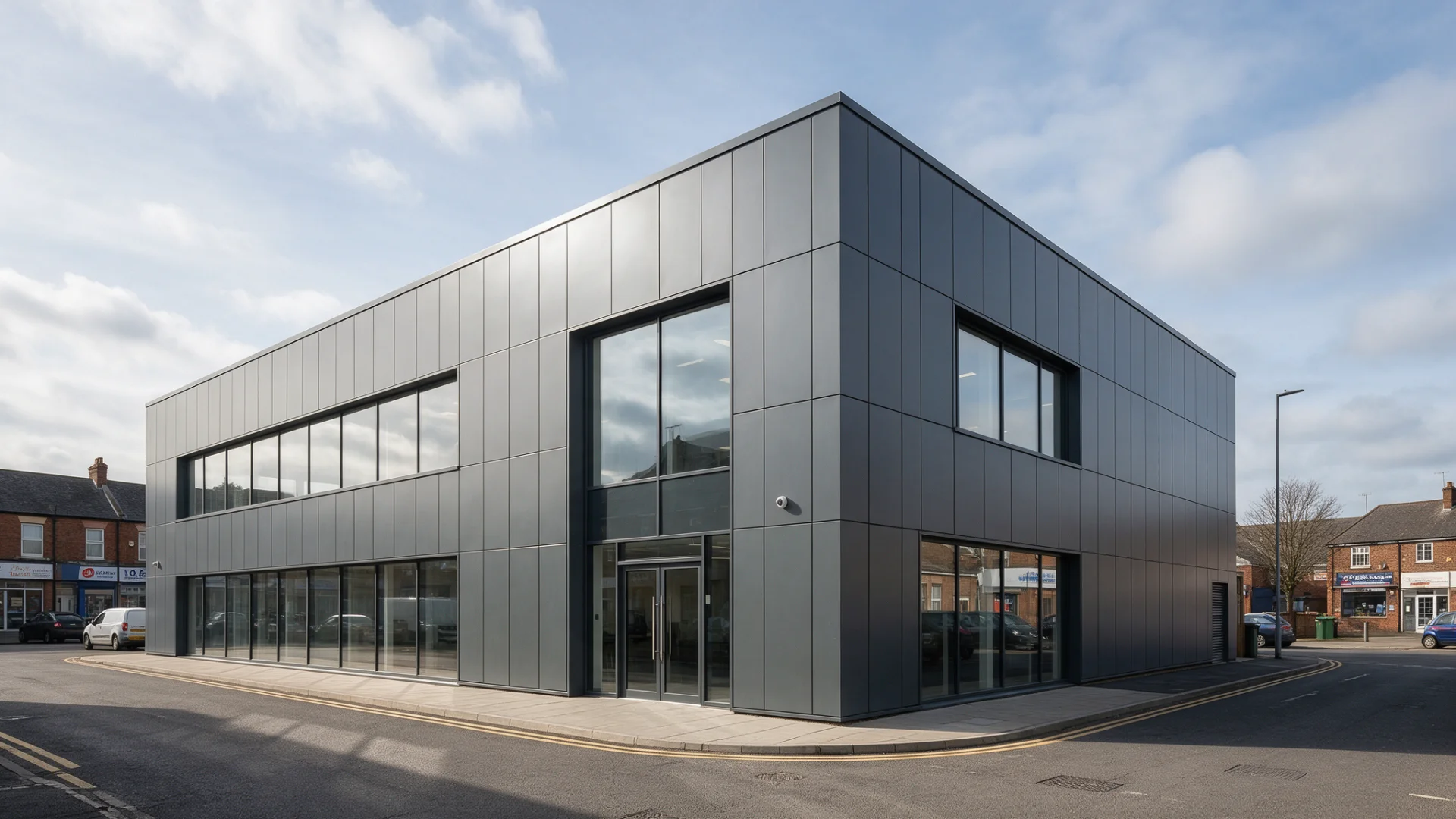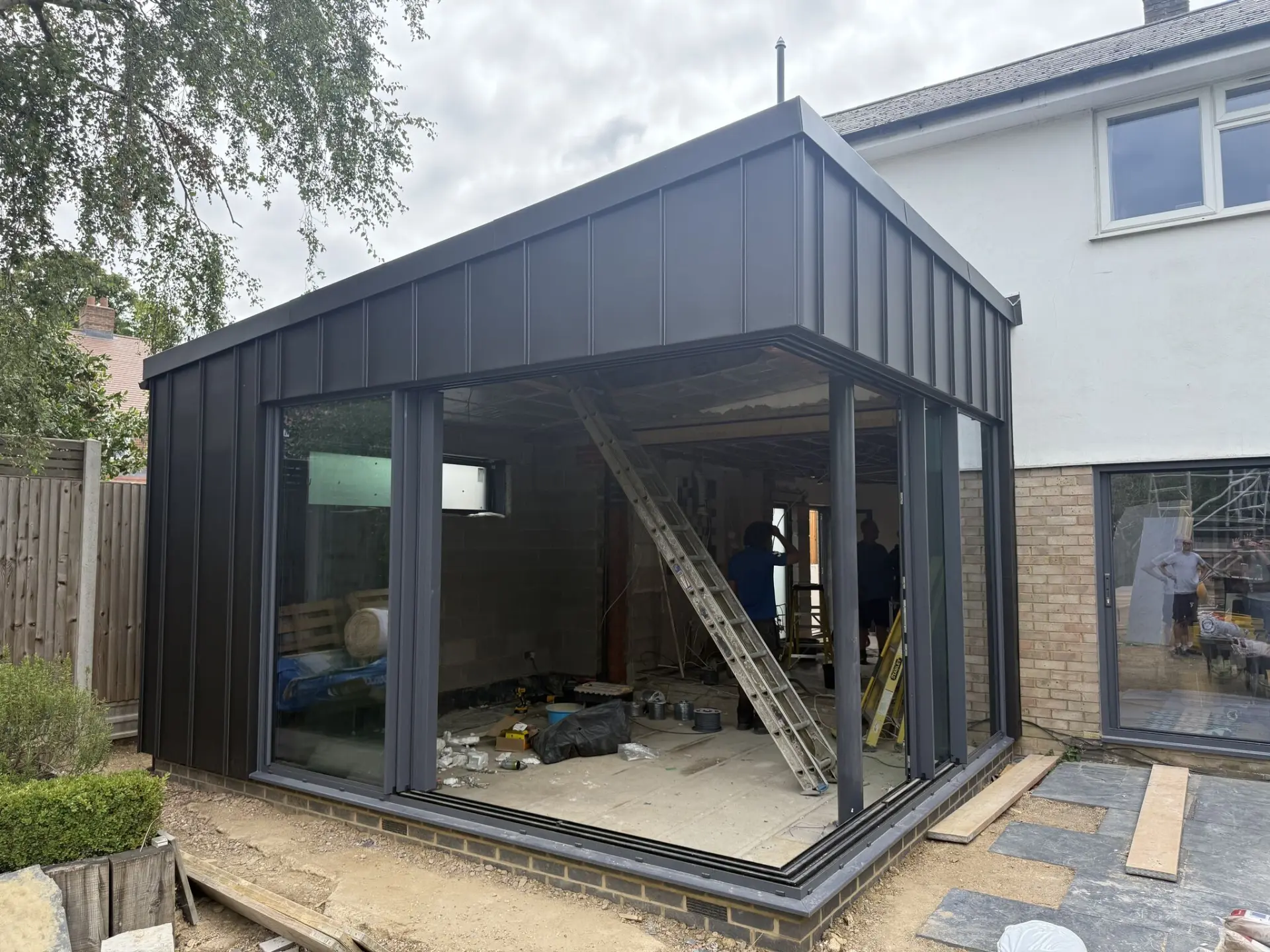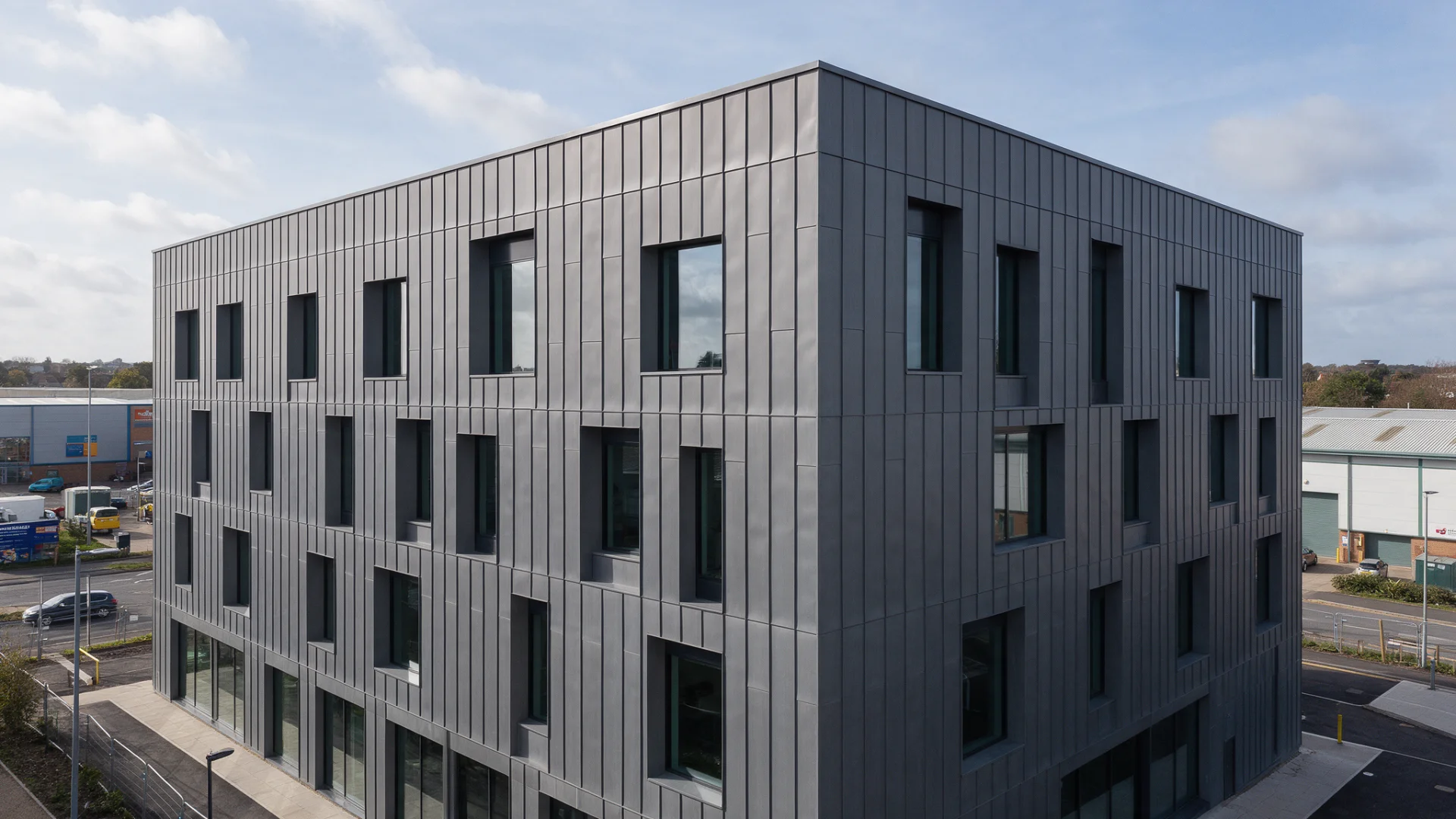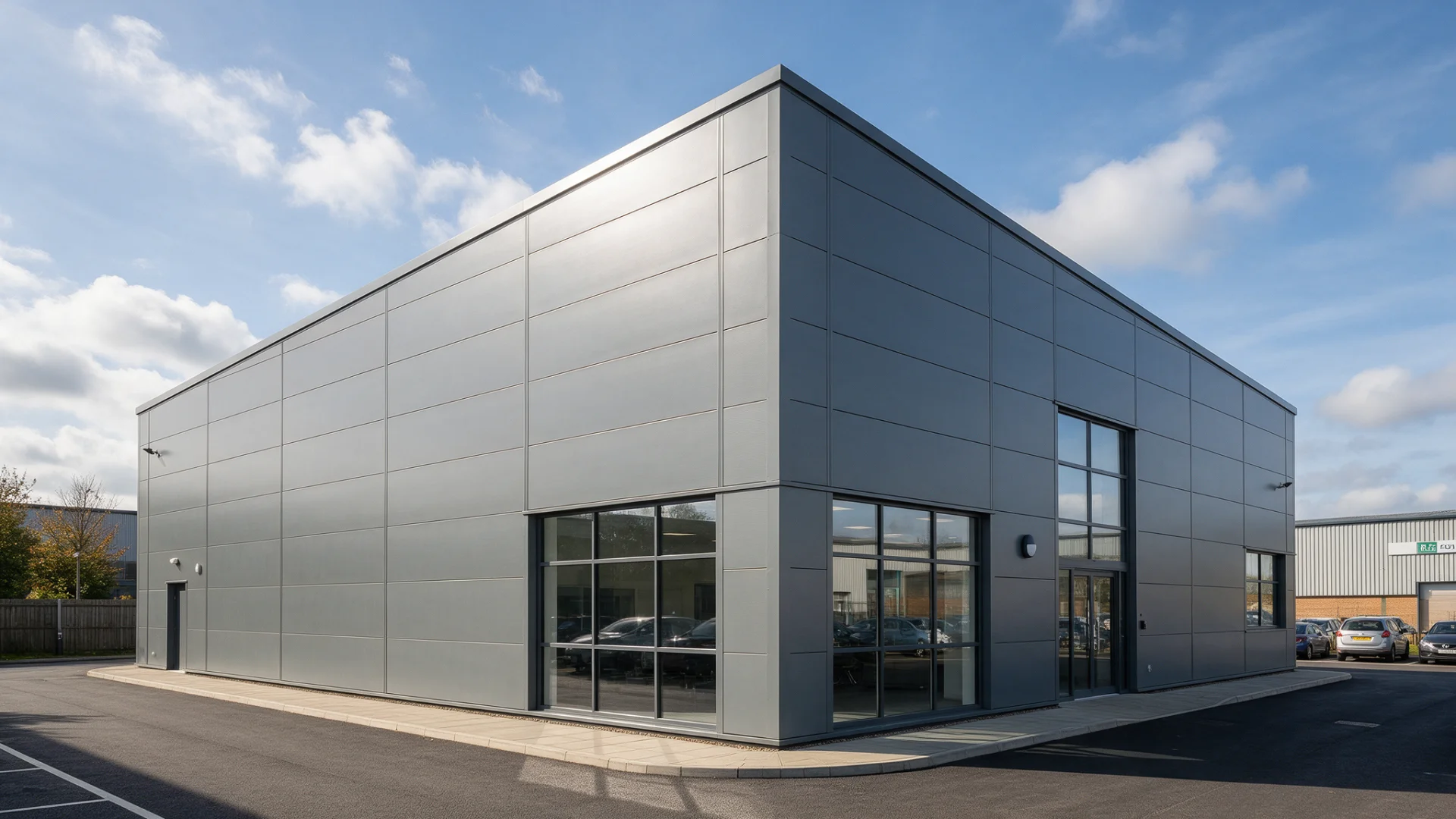
Choosing a metal cladding finish involves more than selecting a grey from a colour chart. The metal, coating technology, surface texture, gloss and panel shape all affect what you see. A finish also has to tolerate the location, fabrication method and cleaning regime. The most reliable approach is to choose the required performance first, narrow the visual options second and approve real assembled samples before placing the order. That process reduces the risk of an attractive digital image becoming a disappointing facade.
Whether you are specifying an extension in Chelsea or a commercial entrance, start with the building's surroundings. Brick colour, roofing, glazing and neighbouring properties create the context in which the metal will be read. A finish that looks restrained on a tiny sample may dominate a whole elevation, while a subtle metallic sheen may disappear when installed in shade.
Start with the architecture and its surroundings
Decide what the cladding should do visually. It might distinguish a new extension from an older house, link a dormer to the roof or give a commercial facade a clear identity. That purpose is more useful than choosing a fashionable colour without considering where it will be used. A building with strong existing materials may benefit from a quieter finish that allows the original fabric to remain prominent.
Look at the elevation from the street and from neighbouring gardens, not just directly in front of a sample board. Consider whether the proposed panel lines reinforce the building's proportions. A pale finish on a tall flat surface can feel quite different from the same finish on narrow standing seams. Establish the panel geometry alongside the palette, because colour and form influence each other throughout the day.
Understand the finish families before comparing shades
Factory-coated metal uses a protective finish to deliver its colour and surface character. Powder coating is one option for suitable fabricated components, while coil-coated products arrive with a finish applied before subsequent forming. Anodised aluminium has another kind of surface treatment. Natural zinc and copper follow different visual ageing paths and should not be judged as if they were painted surfaces.
Each route has its own preparation, manufacturing tolerances and repair methods. A painted imitation of a natural metal may give more predictable initial colour, but it will not develop the same patina. Conversely, a natural surface may vary in ways that are part of its intended character. Ask which appearance changes are expected, which are defects and what the supplier can demonstrate on comparable completed buildings.
Decide how much variation you want
Some clients want a finish that remains visually consistent across a large elevation. Others prefer the depth and gradual change of a natural surface. Pre-weathered zinc provides an initial surface appearance without requiring the owner to wait for natural weathering to develop. It still needs appropriate detailing and is not a promise that every panel will look identical indefinitely.
As checked in October 2026, VMZINC's UK PIGMENTO information lists seven standard colours and explains that its pigment layer retains the texture of the underlying QUARTZ-ZINC rather than producing a flat block colour. That product-specific detail helps distinguish a coloured natural-metal effect from an opaque coating. See the manufacturer's PIGMENTO finish information. The choice should reflect whether visual variation is welcome on your project.
Gloss changes the character of the same colour
A matt surface scatters reflected light differently from a glossy one. As a result, the same nominal colour can appear softer, deeper or more reflective depending on the finish. A high-gloss panel may emphasise waviness and reflect neighbouring windows, while a matt surface can produce a quieter elevation. Texture introduces another variable by creating small shadows across the surface.
Specify the required gloss or finish designation alongside the colour reference. Do not assume that a supplier's standard matt matches another manufacturer's matt. Look at the sample under low-angle sunlight, overcast daylight and shade. Where reflected light could affect nearby properties, review a sufficiently large sample in the intended orientation. Changing the finish after fabrication can be far more expensive than testing its visual effect before ordering.
Metallic finishes need a direction plan
Metallic pigments and brushed or patterned surfaces can have directionality. Rotating one panel may change its apparent tone even when it comes from the same batch. This can make a facade look patchy unless the fabrication and installation teams share a clear orientation convention.
Tata Steel's Colorcoat Prisma guidance advises using one production batch for an elevation where tonal consistency is critical and notes that metallic shades are directional. It also recommends using actual delivered material when matching accessories. These are manufacturer instructions, not a guarantee that every metallic coating behaves identically. See the product's colour-consistency guidance. A panel schedule and orientation marks make those instructions practical on site.
Match trims, windows and fixings deliberately
A colour code is a communication tool, not proof that several products will match exactly. An aluminium window frame, a coated steel panel and a folded zinc flashing can use different substrates and coating processes. Their gloss and texture may make them look different even when the nominal shade is the same.
Approve the actual components together. If exact matching is difficult, a deliberate contrast can be more successful than a near-match that looks accidental. Consider sealants, vent grilles, visible fasteners and rainwater goods at the same time. These small elements often become conspicuous against a restrained facade. The sample approval should record what is accepted for each component, so a late procurement substitution cannot silently change the overall palette.
Colour and solar exposure should be considered together
Dark surfaces often absorb more solar energy than lighter ones, but colour alone does not give a reliable figure for panel temperature or indoor cooling demand. Coating properties, orientation, shading and the wall build-up affect the result. If heat performance is a project objective, request the relevant tested solar properties rather than assuming every white finish has the same behaviour.
Higher surface temperatures also influence movement allowances. A dark south-facing panel may need a different design assumption from a shaded face. The outer metal's temperature does not translate directly into room temperature, because insulation and the cavity change the heat path. Keep the appearance decision connected to facade engineering, especially when specifying long panels or a finish with a strong solar response.
Durability is about the coating system, not the colour name
Two products described as charcoal grey may have very different resistance to weathering. Surface preparation, primer, coating chemistry, film thickness and application control all matter. A finish selected for an interior architectural feature may be inappropriate for an exposed external wall. The colour chart should therefore be attached to a technical specification, not used as a substitute for one.
AkzoNobel's Interpon D Natural Metals product information advertises up to 25 years of coating-performance warranty when applied by an approved applicator. This is a conditional offer for that range, checked in October 2026; it is not a guarantee for every powder-coated facade. Consult the manufacturer's product information and request the warranty terms for the actual location and application. Film integrity and colour retention may have different terms.
The fabrication sequence can affect the final surface
Some finishes are applied before panels are cut and formed, while others are applied after fabrication. Bends, welds, cut edges and attachment points need consideration in either route. A design with very tight folds may exceed the coating's forming limits, and a complex welded piece may require careful preparation to achieve an even finish.
Discuss the fabrication method before approving the aesthetic. Ask where there will be exposed edges, whether protection is required there and how handling marks will be prevented. A sample should include a representative fold or corner rather than only a flat chip. If a decorative face and a hidden return receive different treatments, record that distinction. The places you cannot see after installation may still influence durability and future staining.
Assess the finish against its actual exposure
Rain-washed faces and sheltered soffits behave differently. Dirt and salt can remain on areas that never receive natural washing. A finish suitable for a regularly rinsed wall may need a stricter maintenance arrangement in a deep recess. Nearby trees, traffic and roof runoff also influence the appearance and cleaning needs.
Ask the manufacturer to confirm suitability for those conditions. Do not assume a protective topcoat makes drainage details irrelevant. Staining caused by water from an incompatible adjacent material can spoil an otherwise suitable finish. Keep the colour decision linked to the layout of cappings, drips and downpipes, because visual cleanliness often depends more on where water travels than on choosing a shade that hides marks.
Make sample approval a controlled stage
Use physical samples large enough to show texture and directional effects. Place them vertically where the facade will be seen, beside the actual brick or window material. View them at several times of day. Computer displays and printed brochures can help create a shortlist, but their colour reproduction is too variable for final approval.
For a prominent project, build a small mock-up including a seam, corner, trim and fixing. Record the accepted colour, gloss, texture, supplier, product code and batch requirements. Agree a viewing distance and what degree of variation is acceptable. Keep an approved sample with the project records so delivered material can be assessed against the same reference, rather than against everyone's memory of a showroom visit.
Think about cleaning and future repairs
Choose a finish you can care for safely. A textured surface may disguise minor visual irregularities but hold dirt differently from a smooth one. A very dark wall may show pale deposits, while a light wall may highlight runoff streaks. None of these tendencies makes a finish unsuitable by itself; they help define realistic maintenance expectations.
Obtain the cleaning method before handover and avoid unapproved solvents or abrasive pads. Retain colour and batch information for future repairs, and consider spare panels where the facade is especially visible. Local touch-up coatings may protect damage without recreating the original factory appearance. Knowing that limitation before installation helps an owner distinguish a reasonable repair from an expectation that any scratch can disappear completely.
Bring the visual and technical choices into one brief
For a metal cladding project in Croydon, prepare a short brief naming the intended architectural character, the preferred panel layout and the main exposure concerns. Include photographs of surrounding materials and identify whether uniformity or natural ageing matters most. This gives the fabricator a practical basis for suggesting suitable finishes.
Riverside's service information includes bespoke metalwork and powder-coated or anodised finish options for relevant applications. Confirm the available products for your chosen system and ask for representative samples. Approving the metal, finish and fabricated detail together gives you a much stronger basis for ordering than selecting a colour first and trying to make every later component match it.
The right finish balances the building's character with a clear durability and maintenance specification. Approve physical samples, coordinate directional panels and record the exact products before fabrication begins. Discuss your palette and facade details with Riverside to develop metalwork that looks intentional at the joints as well as across the main elevation.